

Winnipeg Master Class – The Guide, Part Two – Landmarks & Architecture
Esmeralda Fawlty’s* Winnipeg Master Class showcases what you need to know about the city when it comes to culture, attractions and events.
To delve deeper, we’ve created this supplementary guide to our top spots from the video. Below you’ll learn a bit of their history, what the vibes are like and what not to miss when you’re there.
This is your Winnipeg Master Class, Part 2 – Landmarks & Architecture.
Manitoba Legislative Building and grounds
Believe it or not, the city’s most imposing neoclassical building is a hidden temple designed in accordance with hermetic knowledge. English architect Frank Worthington Simon, who fostered the Manitoba Legislative Building with Henry Boddington III, was a member of the Freemasons, and throughout its interior and exterior you’ll find numerous uses of the numbers 13 and 666, along with incredible sculptures like two 13-foot-long bison, gorgons, lions and even two sphinx on its roof –– all designed and carved by the Piccirilli brothers of New York (who notably carved the Abraham Lincoln statue in Washington). And get this: All this trippy freemason stuff lay hidden in plain sight for decades until local architectural historian Frank Albo exposed it all in his seminal work (and former tour) The Hermetic Code – Unlocking Manitoba’s Greatest Secret.
Anyway, the building’s – and indeed Winnipeg’s – most famous figure sits atop; a 17-foot-tall gold-clad sculpture of Hermes called Eternal Youth (whom everyone calls The Golden Boy) that looks north over the city. Behind his golden butt cheeks (Parisian sculptor Georges Gardet didn’t include pants when it was cast in 1918), the south side of the Legislative Grounds contains the Manitoba Plaza with its stately fountain (which Ms. Fawlty walks past; 16 secs) that is a popular summer attraction. There’s also a second fountain north of the building in Memorial Park, which Janis Joplin famously (and illegally!) swam in, in 1970 while touring Canada as part of the Festival Express with The Grateful Dead and The Band.
True North Square
One of downtown’s newest gathering places, True North Square has become the focal point for celebrations related to Canada Life Centre – home to the NHL Jets, AHL Manitoba Moose, Sea Bears basketball team and countless concerts. Its main square is enclosed by two curved towers as seen in the video, while within it you’ll find seating and plenty of space to revel –– like that time Adam Lowry scored the winner in double overtime in Game 7 vs St. Louis, when the square turned into a giant salsa dance party so jovial that they decided to reopen the shipping container bars to ply us all with margaritas (what a night that was! Go Jets Go!). The entrance to the square also features a stirring statue of the late Winnipeg Jets’ legend, Dale Hawerchuck.
Businesses in the square include Modern Ambition’s flagship store (by local company Mondetta Clothing), Lake of the Woods Brew Co’s Winnipeg brewery, and some excellent food options in Hargrave Street Market. Academy Hospitality, a local restaurant group whose flagship restaurant Pizzeria Gusto has been operating since 2008 on Academy Road, runs several of these market concepts, including Yard Burger, The 44 (in partnership with Jets’ standout Josh Morrissey), Rose Bar and the full-service restaurant, Gusto North. The stylish Hargrave Street Market food hall is also home to Saburo Kitchen by award-winning chef Ed Lam, and a coffee kiosk by Empty Cup Collective, another local company that now has seven locations in the city along with new ones opening in Saskatchewan.
Portage and Main
Central Canada’s most prominent intersection was (finally) reopened for pedestrians to cross at street level in summer 2025. The intersection has been celebrated in songs like “Prairie Town (opens in new window)” by Randy Bachman and Neil Young (“Springtime melts the snow, rivers overflow / Portage and Main, fifty below”).
The main buildings on the intersection include Fairmont Winnipeg, the Richardson Building (One Lombard, where our office is located), the neoclassical Bank of Montreal Building that’s now owned by the Manitoba Métis Federation and is being transformed into the Métis Nation Heritage Centre, and 201 Portage, the city’s second tallest building. The corner is often cited as the “crossroads of Canada,” and my friends, it gets windy here. Underneath it, Winnipeg Square provides eateries and shops, along with indoor connections (via heated skywalks) to much of downtown.
Esplanade Riel
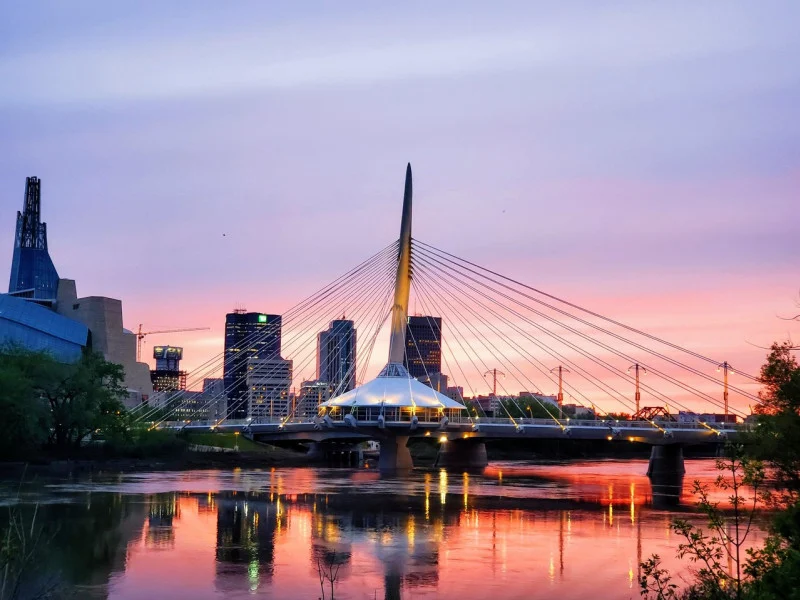
Bridging Saint-Boniface and The Forks, all while being a standout feature on downtown’s skyline, the Esplanade Riel was designed by local architect Étienne Gaboury (opens in new window), who has left a huge mark on Winnipeg’s architecture and design. Named after Louis Riel, the Métis leader who is considered the father of Manitoba, the footbridge spans 250 metres across the Red River.
Co-designed by Guy Préfontaine, the bridge also contains imprinted patterns representing the history and culture of the region. Its side-spar cable-stayed design comes together 57 metres (187 ft) above the bridge deck at its spire, creating a mesmerizing, symmetrical, cable-framed view that photographers simply can’t pass up. The Esplanade Riel also has a 10-minute light show every hour, on the hour, from sunset until midnight. The last show runs from midnight until 12:10 a.m.
Niimaamaa sculpture within Niizhoziibean
In the past few years The Forks has created, to quote national award-winning columnist and author of Wînipêk: Visions of Canada from an Indigenous Centre, Niigaan Sinclair, “one of the largest collections of Indigenous-led public expressions in any historical site in Canada.”
Sinclair is the Indigenous Curator of The Forks National Historic Site and was instrumental in the creation of Niizhoziibean, meaning “two rivers” in Ojibway. This site, located across the Forks Bridge, simultaneously honours the area’s Indigenous history, while also providing a collaborative space for future generations. Here you’ll find works of art like Niimaamaa (“my mother”) — a huge sculpture by KC Adams, Jaimie Isaac and Val Vint that you can see at 1:00 in the video — along with a wigwam created for ceremony, gardens brimming with medicinal plants and signage throughout the area in Cree, Ojibway and Michif.
Nestewaya River Trail
In January and February, downtown’s main rivers transform into a winter wonderland. Spanning nearly seven kilometers in length, the Nestaweya River Trail provides recreational paths for skating, fat-tire biking, cross country skiing or casual strolls. You’ll hear many languages spoken as you see people skating for the first time from The Forks, along with so many dogs with the hugest smiles on their faces (perhaps our favourite part). This naturally frozen trail also features “warming huts” – beautiful and occasionally bizarre structures providing space to tie your skates – that are the result of an international design competition. You can also rent ice bikes, skate assists, and several other modes of ice transportation at points along the trail.
The Exchange District
One of Canada’s architectural marvels, this 20-block district boasts North America’s most extensive (and handsome!) turn-of-the-20th-century buildings. As Alan Doyle, lead singer of Great Big Sea recently stated (opens in new window), “If there’s 100 good-looking buildings in Canada, 45 of them are in Winnipeg.”
These “terra cotta skyscrapers” and brick-built warehouses were the result of Winnipeg’s boom years in the late 1800s to 1913 when we were one of the grain trading capitals of the world, a city with more millionaires per capita than New York that was nicknamed both “Chicago of the North” and “The Gateway to the West.” Then, the Panama Canal was built [*spits on ground], and we lost our geographic prominence – although we’ve kept all these magnificent buildings!
While walking amongst them on these charming streets you’ll find some of the city’s trendiest boutiques and excellent eateries –– including a few of Canada’s best (opens in new window). There are also established galleries, vintage and antique shops and coffee and café culture galore. You just may see a movie being filmed too, as The Exchange often stands in for New York and Chicago in Hollywood productions.
FortWhyte Alive
Six hundred-forty acres of pristine prairie beauty can be explored at this oasis just south of the city. In summer, feel the wind in your hair canoeing or sailing on one of FortWhyte’s lakes. In fall, sip a locally brewed beer at Buffalo Stone Café while migrating birds fill the sky and descend on the lakes at sunset. In winter, go cross-country skiing or snowshoeing on its many trails, or take the kids out for a ridiculously fun day of sliding on the Richardson Rrrun toboggan slide. Its new Buffalo Crossing facility contains the Nature Nook store, event spaces and direct access to Muir Lake all via Canada’s greenest new building. With so much in store, there’s always an adventure to be had at FortWhyte Alive (opens in new window), including getting up close to North America’s largest urban bison herd.
*Kudos to our star, local actress Amanda Shimoji for embarking on this year-long project with us.
Guide and video script by Mike Green.
***
For the full Winnipeg Master Class experience, don’t miss the other instalments:
Winnipeg Master Class – The Guide – Part One: Arts & Culture (opens in new window)
Winnipeg Master Class – The Guide – Part Two: Landmarks & Architecture (opens in new window)
Winnipeg Master Class – The Guide – Part Three: Attractions & Culinary (opens in new window)