

Getting to Winnipeg Guide
How to prepare for a trip to Winnipeg
Whether you’re travelling for business or taking a road trip to Canada for the first time (or the first time with kids!), we’re here to help.
Here’s everything you need to know before you come to Winnipeg, where your US dollar is worth $1.35 Canadian! (Just think about it as saving 35 per cent on everything!)
Step 1: Plan your travel
There are three ways to get to Winnipeg from the U.S.: by road, by bus or by air.
If you want to book a bus, plane or train ticket, book directly through a travel agent or service provider.
Travel tip: Before you book your trip, make sure you and your family’s travel documents are all valid, up to date and accounted for.
By Road
Hop in the car, enjoy the prairie landscapes and you’ll be here before you know it.
The main border crossing in Manitoba is Emerson (opens in new window), where Manitoba No. 75 South connects with U.S. Interstate No. 29 and Minnesota No. 94. Winnipeg is only one hour north of this crossing, and it can be busy during peak times. If you’re driving, you can get your copilot to check border wait times (opens in new window) in advance.
There are several other border crossing points between Manitoba and the U.S., but only Emerson is open 24 hours a day. Be sure to check the hours of operation at the crossing (opens in new window) you plan to use before you leave.
If you are travelling with a group of vehicles, make sure you arrive at the border in the same vehicle as your children.
By Bus
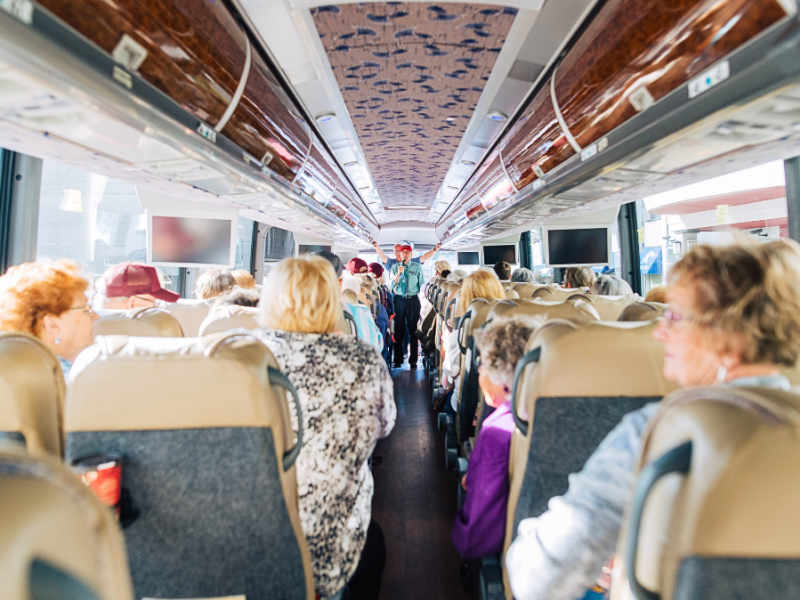
The Winnipeg Bus Terminal is located at Winnipeg James Armstrong Richardson International Airport. All of the major bus lines use this terminal as a bus depot.
By Air
If you’re flying to Winnipeg, you’re likely landing at Winnipeg James Armstrong Richardson International Airport (opens in new window). Richardson International Airport offers non-stop flights from major U.S. airports including Chicago, Denver, Las Vegas, Minneapolis/St. Paul, Phoenix, Palm Springs, and Los Angeles.
Now that your dates are picked and your travel arrangements are set—it’s time to start planning.
Step 2: Pack and prepare like a pro
You might want to put off planning since it seems like a simple trip, but, especially if this is your first time crossing the border, don’t avoid it.
Here are a few things to consider.
Where to stay in Winnipeg
There are a wide variety of hotel options in Winnipeg. Book in advance to make sure the accommodation you want is available.
Exchanging money
Although U.S. currency is usually accepted in Canada, you can avoid any instances where it isn’t by getting yourself some Canadian currency before you leave the U.S. or once you arrive in Canada.
One of the many great things about visiting Canada as an American is the excellent dollar conversion. The Canadian dollar is generally worth less than the American dollar, so you’ll get more bang for your buck when converting currency.
Fun money fact: In Canada, we call one-dollar coins ‘loonies’ and two-dollar coins ‘toonies.’
Packing for the weather in Winnipeg
If there’s one thing we’re known for in Winnipeg—it’s our weather! There are four distinct seasons, so it’s important to pack accordingly. In the summer, the average temperature is +26 degrees Celsius (+78.8 degrees Fahrenheit), and in the winter, you’ll need some extra layers because the average temperature drops to -13 degrees Celsius (+8.6 degrees Fahrenheit).
Winnipeg averages approximately 51.4 centimetres (20.2 inches) of precipitation each year. To compare, this is roughly half the precipitation New York experiences annually.
Be sure to check the weather (opens in new window) in Winnipeg during your trip.
Essential documents to pack for adults
Forgetting to pack something like socks or a swimsuit is no big deal (we have plenty of places to shop in Winnipeg after all), but forgetting the documents you’ll need to present when you arrive at the border can be a problem.
If you are a U.S. citizen or permanent resident visiting Canada (opens in new window), you’ll need proof of citizenship and/or status such as a:
- Passport
- Birth certificate
- Certificate of citizenship or naturalization
- U.S. Permanent Resident Card
- Certificate of Indian Status and photo identification.
If you are crossing the border by air, you need a passport.
Visa-exempt foreign nationals or citizens from select visa-required countries may need a visitor visa or Electronic Travel Authorization (eTA). If this is you, find out who needs to apply (opens in new window) and how to apply (opens in new window).
Essential documents to pack for minors (age 15 and under)
Minors must have proper identification, such as a:
- Birth certificate
- Passport
- Citizenship card
- Permanent resident card
- Certificate of Aboriginal status
Passports are required for air travel, even for minors. However, for a road trip, passports are recommended but not required. A birth certificate is sufficient.
If you’ve been through a separation or divorce and you’re travelling with your child, bring your custody or legal separation documents and a letter of authorization (opens in new window) from the other parent to facilitate the minor’s entry into Canada. The letter should include the other parents’ address and telephone number.
Think twice about bringing these items into Canada
Canada is a very safe place to visit, and we work hard to keep it that way.
There are several restricted and/or prohibited items that are not allowed into Canada at all, or without the correct documents:
- Revolvers, pistols, automatic firearms and silencers
- Explosives, fireworks and ammunition
- Specific food, plants and animals
- Cannabis and other controlled substances, certain consumer products
A common misconception is that because non-medical cannabis is legal in Canada, you can bring cannabis over the border. Don’t fall for this—transporting cannabis into Canada without a prescription is illegal.
Do your research and be sure to bring or obtain the correct documentation before travelling.
Step 3: Arrival and border crossing
So you’ve got your bags, your documents, your travel companions and you’re on your way!
Reasons you may not be allowed to enter Canada
You may be unable to enter Canada (deemed inadmissible) for a number of reasons including impaired driving convictions, human rights violations, participation in organized crime or due to involvement in criminal activity.
What to declare at the Canadian border
Don’t roll the dice on declaring the following items. If you fail to, you could face serious consequences depending on the type of item.
You are obligated to declare the following items:
- Specific foods, plants, animals and other products (use this reference tool (opens in new window) if you’re unsure)
- All money or currency equal to or over CAN$10,000
- All firearms and weapons
Liquor and cannabis laws to keep in mind
While in Winnipeg, you can have fun (in fact, we hope you do!), but you need to follow our laws when it comes to liquor and cannabis. The legal age to purchase and consume cannabis is 19, and the legal age to purchase and consume alcohol is 18.
As of 2018, non-medical cannabis is legal in Canada, but smoking or vaping cannabis is prohibited in public.
Spirits, wine and beer are all available to purchase at Liquor Mart (opens in new window) locations. Wine is also available through private wine stores, and you can purchase domestic beer from hotel vendors. If you’re transporting open liquor, it has to be stored in your trunk. Similar to cannabis, it is illegal to drink alcohol or have open liquor in public places. Save it for when you arrive at a private residence.
Lastly, driving under the influence or consuming cannabis or alcohol in a vehicle is illegal.
What to do in Winnipeg
The real challenge is going to be fitting everything in. Check out this checklist and cross off as many “must-do” Winnipeg things as you can.
Travel tip: If you’re looking to visit multiple tourist attractions, consider the Winnipeg Attractions Pass. With tons of family-friendly places to go, this is an ideal option for families who want to keep their kids busy.
Step 4: Heading home
It’s not a bad idea to start thinking about your return trip before you’re actually en route.
Save all your receipts and remember that just because you purchase something at a duty-free shop doesn’t mean it’s automatically free of duty when you return to the U.S.!
Especially if you’ve never re-entered the U.S. before, check out what to expect (opens in new window) when you cross the border on your way home.
To be safe, double-check the following:
- The value of your duty exemption (opens in new window), which is based on how long you were gone and where you went
- Which duty-free items (opens in new window) you’re allowed to bring back to the U.S.
- Which items are prohibited and restricted (opens in new window)
We miss you already!
For more information on crossing the border into Canada, visit the Canada Border Services Agency’s website (opens in new window) or call 1-800-461-9999.
For more information on crossing the border back into the U.S., visit the U.S. Customs and Border Protection’s website (opens in new window).